Saturday, September 30, 2006

Half Time is Game Time!


This is Homecoming Weekend at Joshua's school. Last night's football game was well attended even though the temperature was a bit chilly. At game time it was about 64F/18C. By the end of the game the temperature had dropped a bit. I was wearing two T-shirts and a sweatshirt, so I didn't start getting cold until near the end of the game. As soon as I got home, I made some hot cocoa!

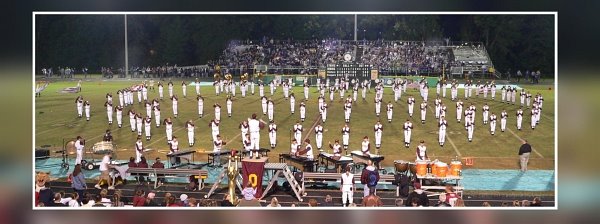
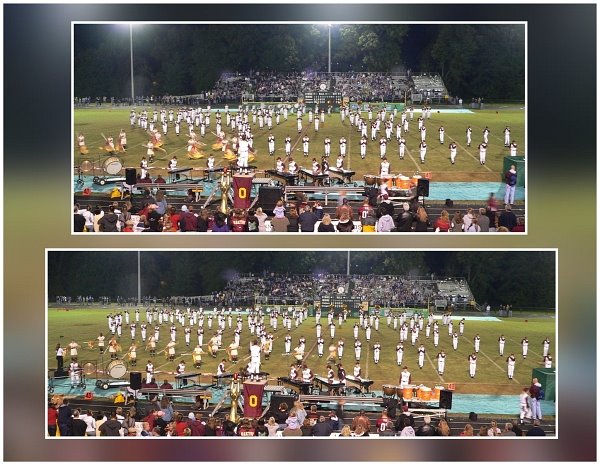
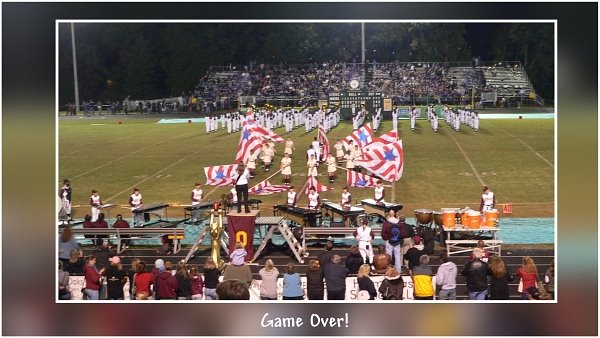
Unfortunately, the home team got slaughtered in the football game. It was pretty much over by the end of the 3rd quarter. Joshua's band did not have a very good night either. He looked at the photos Dave and I had taken and critiqued the formations, etc. He was pleased with the final formation, however, as the band's straight lines were actually pretty straight. If you don't think it's hard to march in a straight line, you haven't marched in a band. The final photo below shows the end of the program. It evokes the movie, Field of Dreams, in which the players exit the ball diamond through the cornfields that border the outfield.

The photo at the top of this post shows the back of my football game T-shirt, which I wore over the sweatshirt. Many of the band parents wear these to the games. There is something of a (not too friendly) rivalry between band parents and football parents. Last year, a band father sued a football father over a nasty incident that occurred at a football game. The band parent won the suit.

Here are a few shots from the half-time show. Sorry, I don't have any from the football game. After all, everyone knows that Half Time is Game Time!


Wednesday, September 27, 2006

Virginia in Black & White

I had two rolls of black & white film developed this week. I've finally decided - firmly, resolutely, with no further doubt whatsoever - that I prefer getting my rolls developed and put on CD and skipping the prints. For one thing, getting prints made doubles the processing costs. For another, I don't have room to store or display hundreds of prints. Finally, I always end up tweaking images before displaying them either on the web or in a frame anyway. Therefore, I might as well just keep all of the post-processing tasks to myself. So much for my idea that film would liberate me from the computer! Oh, well, live and learn. When I get a new computer, I'm also going to get a scanner. That way, I'll be able to scan the developed negatives myself and save the cost of having the developer scan them for me.

Taking photos on black & white film presents some unique challenges. Since the photographer is looking at the scene in color, he or she has to think about how the scene will look as shades of black, white and gray. For example, if one takes a color photo of a red rose against a backdrop of green leaves, the colors are easily distinguished. The same photo in black and white, however, often makes everything look a fairly uniform shade of gray. The way to offset this effect is to use various filters to enhance or subdue particular colors. I need to get some more filters and start learning how to use them.
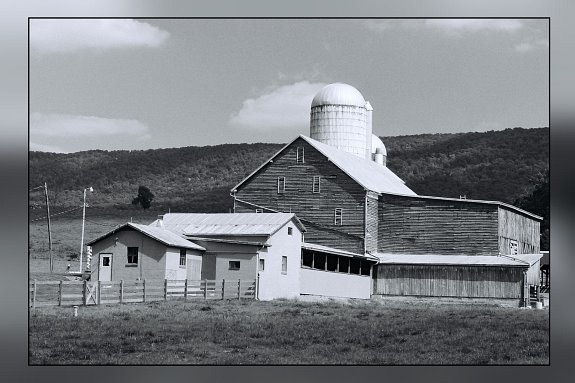
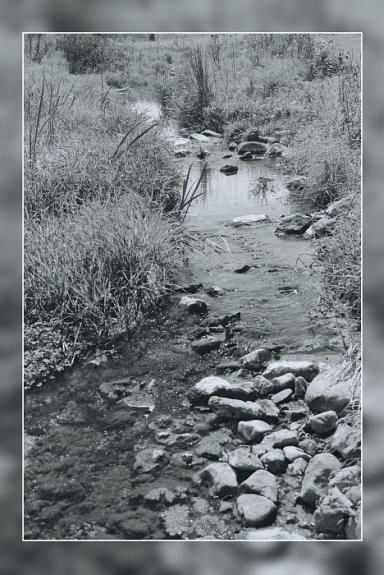
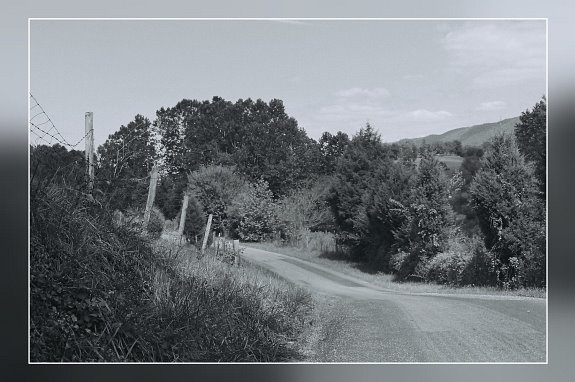
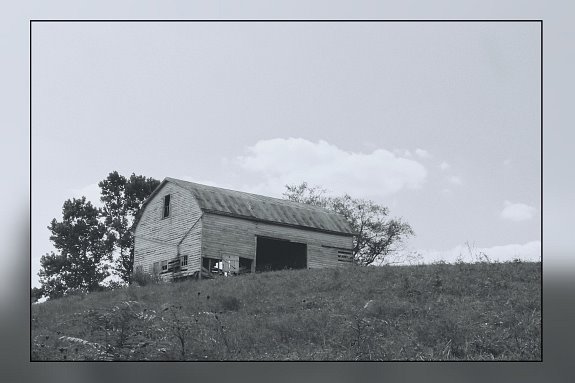
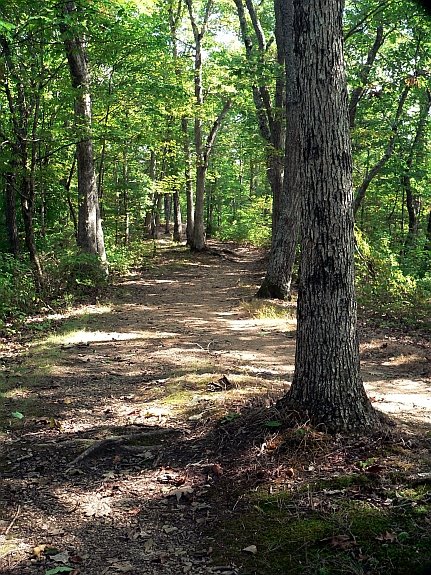
Okay, enough chatter. On to the photos. The rural photos were taken in Virginia's Shenandoah Valley.


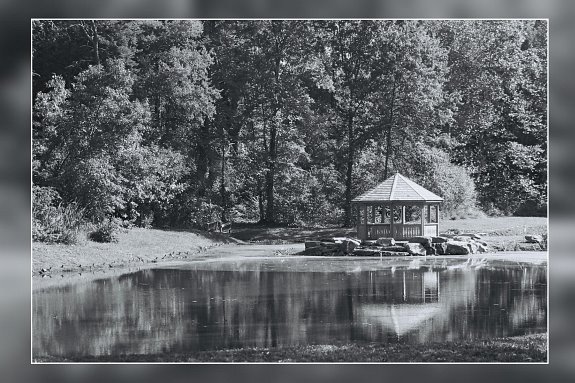
These two were taken in the park near my office. I've flipped the last one upside down to make it look like an impressionist painting.


That's all I have for tonight. Joshua has a football game in a couple of days, so I'll have lots more photos soon.

Tuesday, September 26, 2006

Wild West Virginia, Part Two: A Slide Show

This is a short slideshow featuring
some of our recent vacation photos.

I hope you enjoy it.

Sunday, September 24, 2006

Home Again

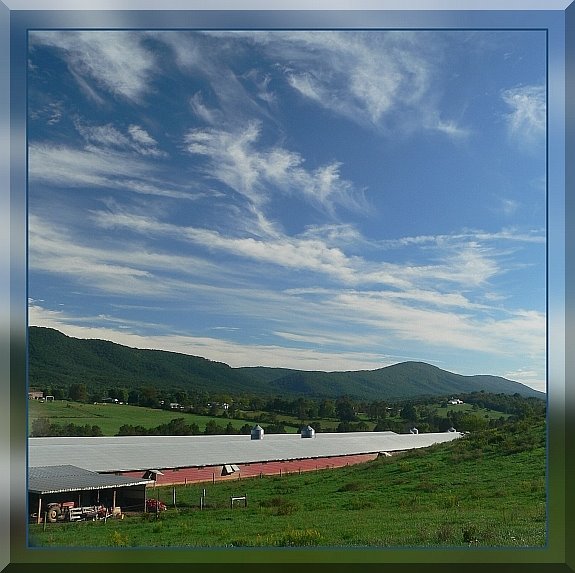
Dave and I arrived home this afternoon. Therefore, I thought it would be appropriate to post some photos that were made in Virginia. The middle photo is a farm that was located just outside of our campground in Harrisonburg. This is typical of the gorgeous scenery in Virginia's Shenandoah Valley.


We had a very enjoyable vacation that ended with us spending most of a day at a marching band clinic/competition. We initially intended to go just to take photos. Those plans were scrapped when Dave got an email saying that our services were needed on the pit crew.

High school marching band pit crews are composed primarily of parents who transport the large percussion instruments, sound equipment, etc., from the high school to the marching venue. In addition to loading and unloading stuff from a semi-trailer, the parents transport the stuff to and from the field and assist in setting up and taking down the stuff on the field. Most of the hauling is done with golf carts and flatbed trailers.

Our percussion pit consists of three timpani, several marimbas, xylophones and vibraphones, chimes, assorted cymbals, woodblocks, etc. In short, stuff that is way too large, heavy or cumbersome for students to carry on the field. This year's show also uses a sound system, as the show opens with a short taped monologue and includes a couple of singing segments. Also, since the theme for this year's show is baseball, we have two "dugouts" from which the color guard members emerge at the beginning of the show. These are cloth constructions on light aluminum frames. Everything I've described thus far is what is included in the "front pit," which is located in front of the marching band, near the drum major's stands. Oh yeah, the parents transport and assemble those too.

In addition to the front pit described above, this year's program includes a "back pit" which is something to behold! In keeping with the baseball theme, we haul and assemble a 30-yard long scoreboard and outfield fence, complete with advertisements and foul poles. The main scoreboard is a wooden contraption, topped with a clock, that's about 10-15 yards long. This thing weighs about 800 pounds, is built onto a flatbed trailer, and is hauled around the field with a reinforced golf cart. The outfield fence, made of cloth, attaches to the wooden scoreboard and is unfurled to attach to painted PVC foul poles on both sides of the scoreboard. This is assembled behind the marching band and is therefore called the "back pit." Since I was working the back pit yesterday, I didn't get any pictures of it. Dave got a really nice one - I'll have to get him to post it on his blog.

If you've read through and digested all of this information, you may be surprised to know that all of these pits and props need to be hauled onto the field and assembled in 2-3 minutes. Then, when the show is over, we get another 2-3 minutes to dismantle everything and haul it away again. Also, the band gets a certain amount of time to complete their show in competitions. If they exceed their time limit, points are deducted from their score. The clock begins as soon as anyone steps over the sideline into the field of play. So, when parents are scrambling around assembling stuff, they have to be careful not to step over the line and cause the clock to start too early. All in all, working the pit keeps one pretty busy. Nevertheless, I'm sure that Dave and I will be posting lots of marching band photos in the coming days.

Wednesday, September 20, 2006

Wild West Virginia

Dave has already filled you in, for the most part, on some of the most exciting events of our vacation thus far. As I write, he is looking at a brochure for some whitewater rafting on the Shenandoah River (which is near our current campground in Harrisonburg, VA). He's looking at the map and smirking as he reads about the various rapids and their ratings: I, I, II, I, etc. Having just completed two legs of the Gauley River, he is not the least bit interested in doing a gentle float down any river. As he says, he's not interested in doing anything less than lots of class IV, V and V+ rapids now. And you know what? I agree with him. We both want more rip-roaring challenging runs. We're already talking about checking out the Colorado River next spring. No, not the 21-day run - just a day (or maybe two).

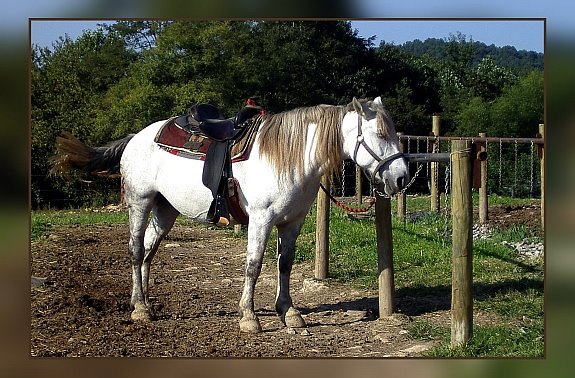
On the evening before we went rafting, we took a two-hour horse ride in the mountains of West Virginia. This took us deep into the forest and across a number of ridges that overlooked some amazing countryside. The photos below give you some idea of what we experienced. It was really interesting to view the same countryside from the highest points from horseback and the depths of the riverbed on a raft. What a contrast in persepectives!

Having experienced horseback riding and whitewater rafting back-to-back, I've decided that rafting is definitely my preference. You can keep the saddle, just give me a paddle.

As Dave mentioned in one of his posts, we both went overboard during our rafting trip. Dave's two falls won him the most Frequent Swimmer Miles for our raft. His first tumble was actually rather nasty, as he was plunged into an eddy called, The Toilet Bowl. He probably was underwater for about half a minute. I kept looking into the swirling current and wondering, "Where is he?" Man, was I relieved when I finally spotted him thirty yards or so downstream.

One of the interesting things we did, several times, was to paddle upstream back into a rapid we had just run so that we could catch the wave and "surf." It was really pretty cool. Once we got on top of the wave, we put our paddles on the floor, grabbed the chicken lines and held on for dear life as the wave continually bounced us up and down and overflowed into the raft a few times. If you haven't done it, you're probably thinking it's pretty insane to get through a rapid, then voluntarily re-enter it. The payoff, however, is that the sensation of surfing a rapid is much different than that of running it.

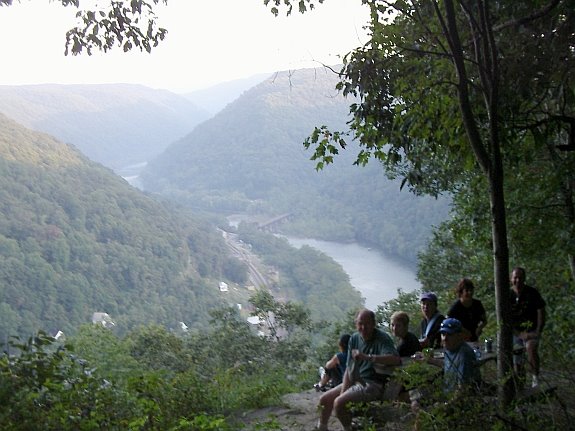
The photos below are pretty self-explanatory - all taken in West Virginia. The final one was taken as my horse walked along an overlook. The river below is the New River, which borders the ACE Adventure Complex. This one is not as challenging as the Gauley, but it's still a pretty good rafting destination.


Thursday, September 14, 2006

Gems #3

Last night I attended a memorial service for a fellow from work who died recently. Steve was the intake counselor at our center. One of his responsibilities was to work with people as they entered our program, a long-term rehab program for people recovering from drug and alcohol addictions. He interviewed them when they came in and helped them get adjusted to life in our center. Steve was uniquely suited for this position because he himself was a graduate of our program. His life was a remarkable testimony to God's power to transform anybody.

As a result of his previous addictions, Steve was HIV positive. In the last few months of his life, he was in terrible pain. The thing is, he never appeared to be suffering, he never spoke about it and he kept working right up until the weekend he died. God blessed him with 17 years of life after he became ill and Steve filled every day of every year with as much life, love and meaning as possible.

Steve's greatest gifts were his capacity to love others unconditionally and to encourage them. Even though his job was officially done when guys graduated from the program, Steve kept in touch with many of them for years after their departure. He continued counseling and encouraging them because he genuinely cared about them, not because it was - or had been - his job. I never heard Steve lose his temper and I never saw him give up hope. Sometimes the guys he worked with got angry. Sometimes they stopped believing that they'd ever overcome their addictions. But Steve never joined them in their despair. Many times, he was the one person in their lives who was able to see them through their dark times.

Even though I, along with many others, miss his gentle ways and his smile, I'm glad that Steve is no longer suffering. Heaven has been greatly enriched by his presence. And my life has been greatly enriched by his.

Tuesday, September 12, 2006

The Last Secret

Authors: Lynn Sholes & Joe Moore
Publisher: Midnight Ink
ISBN: 0-7387-0931-X


The Last Secret
is the second installment of a new series featuring a heroine with the distinctive name of Cotten Stone. In addition to her idiosyncratic name, Stone carries a unique heritage: she is half-human and half-Nephilim.

The Nephilim are a legendary race of giants featured in the Old Testament book of Genesis. Having cast their lot with Lucifer, they were condemned by God to roam the earth forever, unable either to die or re-enter heaven. They seek to avenge themselves by corrupting God’s favorite creatures, humankind. Notwithstanding her Nephilim blood, Cotten Stone identifies with humanity and fights for its survival in the eternal war between the forces of iniquity and purity.

In The Last Secret, Stone is engaged in a race against the Nephilim. The prize they seek is an ancient crystal tablet engraved – perhaps by the hand of God himself – with mysterious glyphs. Stone wants to uncover its message, which is vital to humanity’s survival, and the Nephilim want to destroy the tablet before its message can be revealed. Although Stone’s encounters with the Nephilim are sinister and deadly, she ultimately prevails in this struggle. She finds the tablet, translates its message and leads many humans to safety. Stone knows, however, that she has merely won one battle against the Nephilim. Many more people need her help if they are going to have any hopes of winning the war against evil. Thus, the book closes with Stone preparing for the next stage of her war against her ancient foes.

Sholes and Moore are experienced authors whose expertise is evident in the careful manner in which their plot is revealed and resolved throughout the book. Key pieces hold together throughout the book and no inexplicable threads are left dangling at the end of the story. Moreover, the story closes in a satisfactory manner while successfully setting the stage for the next book in the series.

Additionally, Sholes and Moore’s development of their main character, Cotten Stone is subtle and appealing. In spite of her unusual lineage, Cotten Stone is a surprisingly accessible heroine with whom the reader can identify. She suffers personal and professional setbacks. She is frequently plagued by self-doubt. She is intelligent but not brilliant. Her athletic prowess is average. In short, she is an ordinary person, not a superhero. Achieving this balance in an unusual character like Stone is a notable accomplishment that would have eluded less skilled writers.

Unfortunately, Sholes and Moore did not take similar care in constructing their secondary characters. For example, the mathematician who helps Stone decipher the tablet’s engraving is a stereotypical brilliant nerd with no social life and the personality of a rusty nail. Resorting to this sort of cardboard character cheapens the quality of an otherwise engaging story. Why are so many bland characters across so many books in so many genres cast as mathematicians? Why can’t someone write about a mathematician with sex appeal or a sense of humor? Such mathematicians exist in real life. Surely they can exist in an author’s imagination.

Another weakness is that Stone’s relationships with key characters, such as her mentor and her best friend (a priest with whom she is in love) are undeveloped. I hope that both of these relationships, particularly the latter one with its enticing portent of passionate tension, will be fully cultivated as the series progresses.

Overall, in spite of these weaknesses, The Last Secret is an entertaining book. I recommend it to readers who enjoy fantasy and adventure stories.

Monday, September 11, 2006

Gems #2

Today I will write about two gems, Commissioners Jim & Carolyn Knaggs.

I first met Jim & Carolyn when they were cadets in the USA eastern territory. Their summer appointment was to lead a divisional "gospel team" that toured about twenty corps throughout the Pendel division. Jim & Carolyn were in their early twenties and most of us on the team were in our mid to late teens. Looking back now, I don't envy them one bit. Among other things, they had to deal with an awful lot of raging teen hormones. I'm sure it wasn't easy. I'll admit that, on one occasion, I was on the receiving end of a particularly stern lecture about adhering to appropriate curfew requirements.

Jim & Carolyn strongly influenced me in two ways. First, through their lives and personalities, they showed me that one could be young, cool and Christian. I didn't really believe that combination was possible until I got to know Jim, Carolyn and the other team members. Being young and rather foolish at the time, I believed that being cool was much more important than being Christian. Over the course of the summer, Jim & Carolyn helped me reorganize my priorities.

The second way Jim & Carolyn influenced me was by the example of their marriage. It was evident to all who knew them that they were made for each other. Their love was vibrant, deep and mature. They were each other's best friends and they obviously enjoyed being together. Nevertheless, they also respected each other's individuality. This combination of passion, companionship and respect showed me the kind of relationship that I wanted to have with my husband.

When Jim & Carolyn were commissioned, their first appointment was to, once again, lead the Pendel divisional gospel team. I was thrilled, but I knew that they were somewhat disappointed. After all, they really wanted to be corps officers, like their peers. Also, Carolyn was pregnant and she did not relish the idea of spending hot summer days riding in vans, setting up sound equipment, holding open airs, etc. Nevertheless, they quickly swallowed their disappointment and wholeheartedly threw themselves into the task of leading a bunch of high energy, hormone-driven teens through yet another summer. And they never complained about it (not in front of the kids, anyway).

I have crossed paths with Jim & Carolyn several times since those hot summer days of years past. Every time we meet, the intervening years evaporate and we renew our friendships as if we had just seen each other last week. I last saw them just a few days before they left the USA to assume their new command in the Australia East Territory. I know they will serve the Lord well there, as they have in all of their appointments, and they will return with lots of slides (probably digital ones now) and memories. Even though it will probably be a few years before I see them, I'm looking forward to the time when we will
once again renew our bonds.

Friday, September 08, 2006

At the Park - Again

I'm still hanging around the park on my breaks. I took these photos yesterday with the digital camera.

First up - a bee hard at work.

Next, a flower with an intriguing pattern and vibrant colors.

I found this guy rummaging around on the ground.

Another bee. It's pretty scary shooting these guys, as I'm usually surrounded by a couple of dozen bees. I've got to remember to take a close-up lens so I can really zoom in on their details (and not have to stand quite so close).

I loved the way the light was filtering through the trees on this flower and its leaves.

Thursday, September 07, 2006

Film Photos

I took these last week using my last roll of color film. The park is quite a lively place. Sometimes one just has to slow down and take time to pay attention to the little things that go on around us all the time. I'm working on a roll of black and white film now. Perhaps I'll come up with something good enough to share.


One huge advantage that film has over most digital cameras is the ability to get a really shallow depth of field. That's how one gets a nicely blurred background in macros, close-ups, portraits, etc. Digital cameras (except for the expensive professional SLRs, some of which have full-sized sensors) struggle with shallow depth of field because of their small sensors.

On the other hand, digital cameras excel at deep depth of field (great for sweeping landscape photos, etc.). Again this is because of their small sensor sizes.

Another advantage of digital cameras is that their lenses can be much smaller than their film counterparts. You guessed it - because of the size differences between 35mm film and many digital sensors. This is why so many fairly compact digital cameras can have 10-12x zoom ranges and why even credit-card-sized cameras frequently have 3-6x zoom ranges.

I seem to gotten off topic. My original intention simply was to share some photos. Somehow I got from there to a lesson on the physics of photography. Anyway, I'll share some more photos - digital and film - as time goes on.

Wednesday, September 06, 2006

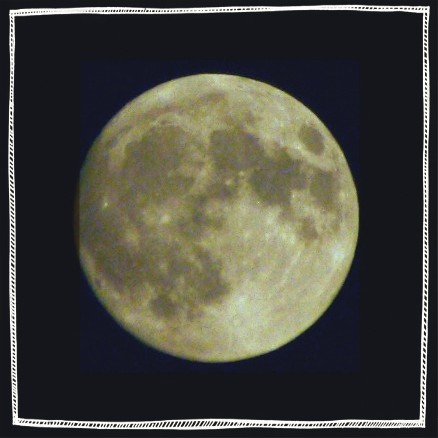
Moonlight

Shot this tonight from my balcony.

Take Me Out to the Ballgame!

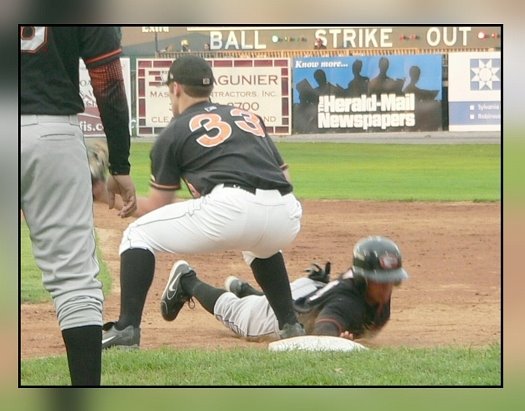
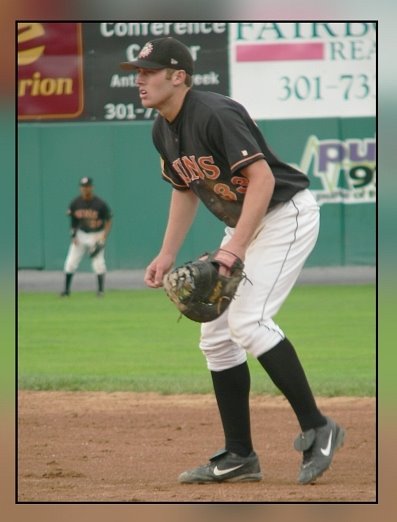
As Dave mentioned in his blog the other day, the Sears family spent this past Sunday evening at Municipal Stadium in Hagerstown, Maryland. The weather was perfect for a twi-night doubleheader. Best of all, the home team won both games!

When we drove to the stadium on Saturday to buy the tickets, Joshua quickly noted, "The tickets are really cheap!" Yes, minor league baseball is still family-friendly: you don't have to spend your child's college tuition to get into the stadium. That's why we were able to sit in VIP seats - front row, first-base line.

The second game was a gem. The pitcher came within one pitch of recording a perfect game. He ended up with a one-hit, one-run game. What a masterful performance. It's the closest I've ever come to seeing a perfect game. And I've seen some pitchers who are, or soon will be, in the hall of fame.

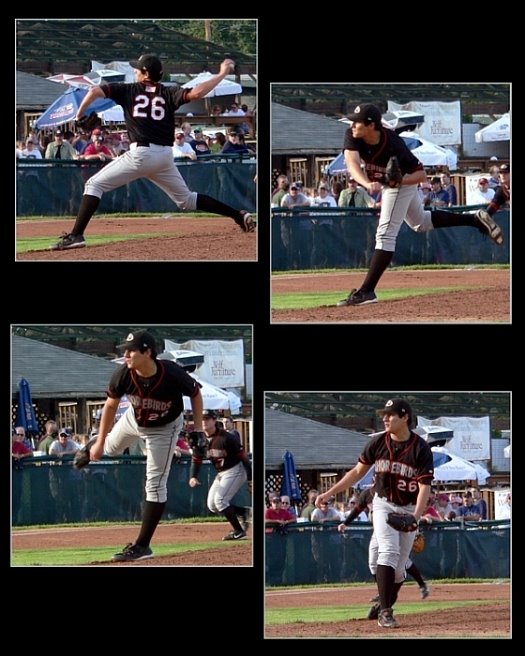
The sequence in the first photo below is the anatomy of a pitch thrown by the visiting team's starting pitcher in the first game. I love burst mode - I shot 4 frames in one second to get this sequence.


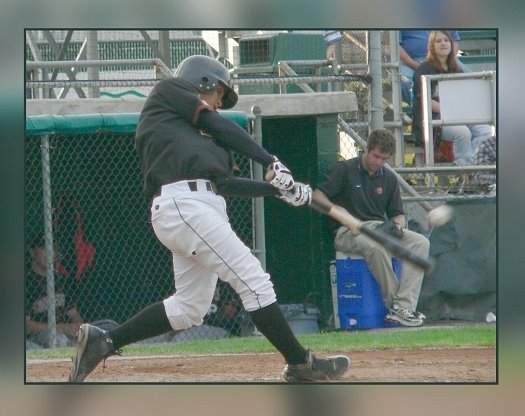
The next photo is the best batting shot I got all evening. My shutter speed was a bit too slow (1/640) to completely freeze the action of the bat and ball. I'll have to work on that.


Since we were sitting along the first base line, I got some decent shots at first base.


All in all, it was a very satisfying night out with the family. It's too bad the minor league season is over. Now I'll have to join legions of other folks in saying, "Wait until next year."

Tuesday, September 05, 2006

Sweet Sixteen!


Today is Joshua's 16th birthday. Wow! It's hard to believe my baby started 11th grade today, is learning to drive and is almost all grown up. Those 16 years have flown by quickly. Time moves a lot differently when you become a parent - it speeds up! I'm sure this is a fully documented, clearly explicated scientific phenomenon! When I think back to September 5, 1990, it doesn't seem like it was that long ago. I still remember clearly the hot September day in Winnipeg when I worked a full day, went home and took a nap, then was rudely awakened by a contraction.

This evening we will go out for dinner at Outback. After that, we will go home and have some birthday cake, then watch the Drum Corps International program on ESPN. I hope it's on ESPN's HDTV channel.

Even though it's birthday number 16, the festivities will be fairly low-key. After all, he just got back from Europe a few weeks ago. That trip was his birthday present. Josh is pretty cool with that, as he doesn't really have a wish list of stuff he wants right now. He's got what he needs and pretty much anything that he's wanted: a cell phone, an iPod, a trombone. . . . Next year, however, he'll probably want a car or some other such trinket! We'll deal with that when the time comes. For now, I just want to wish Joshua a happy 16th birthday.

Friday, September 01, 2006

Minutemen

What follows is the latest book review that has been published at BookPleasures.com. Canadian readers will get a good laugh at one point - you'll know it when you see it.


*************************************************

Minutemen: The Battle to Secure America's Borders

Authors: Jim Gilchrist & Jerome R. Corsi
Publisher: World Ahead Publishing, Inc.

ISBN: 0-9778984-1-5

The United States Census Bureau estimates that roughly 10-12 million illegal immigrants live in the USA today. Some researchers, believing it is necessary to account for the government’s inevitable under-sampling of the illegal immigrant population, believe that 20 million is a more realistic estimate. The vast majority of these immigrants are Hispanics who have entered the USA from Mexico.

Illegal immigration is an increasingly volatile issue in American politics. Many people want to decriminalize illegal immigration. Others want current immigration laws to be enforced more effectively, even if that necessitates the deportation of several million people. Gilchrist & Corsi belong to this latter group.

Jim Gilchrist conceived the Minuteman Project as a means to demonstrate that it is possible to guard the US-Mexican border effectively. In April 2006, approximately 1,000 Minuteman volunteers armed with lawn chairs and binoculars took up positions along the border between Arizona and Mexico. Their task was to observe and report their findings to the US Border Patrol. The Minutemen only interacted with immigrants to provide water and blankets as needed. During the period of the Minutemen’s surveillance, the flow of illegal immigrants from Mexico into Arizona diminished substantially.

The Minutemen seem to have demonstrated that an increased physical presence along the border will go a long way toward stemming the northward flow of humanity. If that is so, why hasn’t the US government trained and hired more border guards? Gilchrist & Corsi believe the answers to that question are rooted in myriad political considerations.

According to Gilchrist & Corsi, most radical left wing, and less-radical Democratic, politicians hope to incorporate the newly arrived Hispanics into their voter base. The authors also believe that left wing American labor unions hope to regain political clout and new members (along with their dues) from among the new arrivals. Gilchrist & Corsi go on to assert that the Catholic Church hopes to increase its membership and income base by incorporating the illegal immigrants, many of whom are Catholic, into their ranks. As far as President Bush’s apparent disinterest in addressing the issue of illegal immigration, the authors claim that he is driven by a vision of a transnational economic (and, ultimately, political) union of the USA, Canada and Mexico.

By now you’ve probably figured out that the authors have an unambiguous right wing, Republican bias. This being the case, they take pains to carefully distinguish President Bush from the remainder of the Republican Party. Moreover, they repeatedly chastise Democrats, radical leftists, labor unions and – to a lesser degree but no less critically – the Catholic Church. And they present the radical Reconquista movement as if it is the prevailing Mexican viewpoint. (Even if it is, how does it differ from the USA’s 19th century Manifest Destiny doctrine, except in not being American?)

On the other hand, Gilchrist & Corsi studiously avoid acknowledging that many, if not most, of the businesspeople who employ illegal immigrants are conservatives and Republicans. They agree that those who employ illegal immigrants contribute to the problem, but, unlike their approach to left-wingers, when they talk about employers (which they don’t do often), they never name names or identify political leanings. Recurrent and obvious biases such as these severely undercut their arguments.

When Gilchrist & Corsi avoid political mud-slinging, extremist suppositions and slippery slope arguments, they present some cogent cases for their positions. They discuss – intelligently, in depth and with appropriate data – the economic, social, criminal, judicial, security and political consequences of illegal immigration. These arguments deserve careful scrutiny, but it’s difficult to give them their due when one has to rake through mounds of overtly biased verbiage to get to them. If the authors would have restrained themselves and avoided taking cheap political pot shots, the book would be much more persuasive.

I recommend this book to anyone who is interested in American political and social documentary. Regardless of your stance vis-รก-vis the authors’ political agenda, the book provides some stimulating food for thought. Perhaps you will be swayed by Gilchrist & Corsi’s arguments, or perhaps you won’t. One thing I guarantee is that you will be challenged to think about them.